


Orbital Data Centers: The Challenge of Cooling Compute in Space

Cooling orbital data centers is challenging because spacecraft cannot rely on air or liquid convection to remove heat. In the vacuum of space, heat can only be rejected through thermal radiation, requiring large radiators and highly efficient thermal transport systems. Advanced technologies such as heat pipes, vapor chambers, and pumped two-phase cooling loops help move heat away from high-power GPUs, but thermal management remains one of the most significant engineering constraints for space-based computing infrastructure.
KEY TAKEAWAYS
- Orbital data centers are thermally feasible, but cooling them is far more challenging than cooling terrestrial data centers because radiation is the only available method of heat rejection in space.
- Radiator design drives system performance. Maximizing radiator temperature, maintaining uniform heat distribution, and minimizing solar and Earth heating are critical to efficient thermal management.
- Advanced thermal technologies such as heat pipes, vapor chambers, and pumped two-phase cooling systems are essential for transporting high GPU heat loads to radiators efficiently.
- Successful orbital data center designs require careful optimization of orbit selection, spacecraft pointing, power generation, thermal architecture, mass, and reliability.
Why Cooling Orbital Data Centers Is Harder Than You Think
As demand for AI compute continues to surge, the concept of orbital data centers is moving quickly from science fiction to serious engineering discussion. Space-based compute platforms promise access to continuous solar power, global connectivity, and reduced terrestrial infrastructure constraints. But one challenge remains unavoidable:
How Do You Cool a Data Center in Space?
On Earth, heat rejection is relatively straightforward. On orbit, thermal management becomes one of the defining system-level challenges. Without an atmosphere, convection cooling disappears entirely, forcing engineers to rethink how heat is generated, transported, and rejected.
Why Data Centers Generate So Much Heat
Modern AI and high-performance computing platforms rely on GPUs that consume hundreds of Watts each. All that electrical power eventually becomes heat.

Whether deployed terrestrially or on orbit, GPUs require:
- Stable power delivery
- Heat rejection
- Protection from thermal cycling
On Earth, hyperscale data centers usually use a closed liquid loop to pull heat off the chips. This part still works in space. However, on Earth, that liquid loop then rejects its heat to the external environment via air cooling, water cooling, or evaporative cooling. None of these are possible in space.
Why Space Is Harder
The space environment eliminates two of the three major heat transfer mechanisms:
- ❌ Convection does not exist in vacuum
- ❌ Conduction to the environment is impossible
- ✅ Radiation becomes the only way to reject heat
That means orbital data centers must radiate heat away using large radiators that emit infrared energy into deep space. While the temperature of space itself is extremely low, removing heat is still difficult. Radiation (at the relevant temperature range) is inherently less mass-efficient than convection-based cooling.
As GPU power densities continue to increase, radiator sizing quickly becomes a dominant spacecraft design constraint.

The Thermal Physics Behind Orbital Data Centers
The governing principle behind spacecraft heat rejection is the Stefan-Boltzmann equation:

This relationship shows that radiator performance depends heavily on:
- Radiator temperature
- Surface emissivity
- Radiator area
Because radiator performance scales with temperature to the fourth power, spacecraft designers are strongly incentivized to operate systems as hot as components can safely tolerate. For orbital data centers, this creates two critical optimization problems:
- Higher temperatures reduce radiator size (and thus mass), but higher temperatures reduce component reliability
- Keeping the entire radiator surface at the same (high) temperature reduces radiator size, but may require additional mass to achieve
Solar Arrays vs. Radiators: A Constant Tradeoff
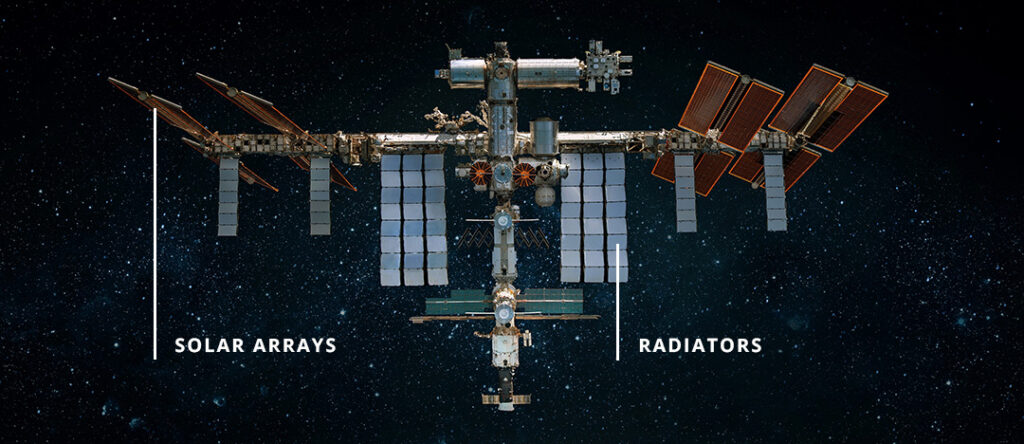
Orbital data centers require two kinds of huge flat plates: solar arrays to generate power, and radiators to dissipate heat. However, there’s a geometric problem: solar arrays want to face the Sun directly, while radiators want to avoid sunlight as much as possible.
This creates competing spacecraft orientation requirements. In many satellite architectures, engineers must carefully optimize spacecraft pointing (or orient solar arrays and radiators independently) to maximize power generation while minimizing solar heating.
When a radiator cannot be kept out of sunlight entirely, solar-reflective radiator coatings are critical design elements. White paints and mirrored surfaces can reduce absorbed solar energy, but these materials degrade over time in the space environment due to:
- UV exposure (especially UVC, which is barely present on Earth thanks to the ozone layer)
- Atomic oxygen
- Ionizing radiation
Coating degradation is significant on satellite timescales (2-10 years) and can massively reduce the thermal performance of a radiator.
Heat Pipes and Advanced Thermal Transport
Due to the high heat flux (i.e. high heat in a small area) of modern GPUs, spreading heat evenly across the radiator using only conduction in metals, carbon fiber, or graphite requires a lot of mass. One of the most effective tools for orbital data center cooling is passive two-phase heat transport. Heat pipes and other passive two-phase technologies use a liquid/vapor phase change to move heat across large distances with high mass efficiency and no mechanical pumping required.
A heat pipe is a sealed tube containing a fluid held right on the edge between its liquid and vapor phases:
- Liquid evaporates near the heat source and picks up heat
- Vapor distributes evenly through the tube
- Vapor condenses on colder walls and releases heat
- Capillary action returns the liquid to the heat source
This allows spacecraft to spread concentrated GPU heat loads across large radiators with minimal temperature drop and without breaking the mass budget.
For high-power orbital compute systems, thermal engineers may use various form factors of two-phase technologies. Common constructions for this temperature range include aluminum walls with ammonia inside and copper walls with water inside.
- Heat pipes
- Vapor chambers
- Oscillating or pulsating heat pipes
- Pumped two-phase loops
Each architecture offers different tradeoffs between:
- Mass
- Reliability
- Heat flux capability
- Scalability
- Manufacturability
Why Pumped Two-Phase Cooling May Be the Future
Passive two-phase cooling works well to move heat over short distances. This is useful for orbital data center designs where the GPUs are attached directly to the radiator, evenly spaced every meter or two. However, other conceptual designs use densely packed bricks of many GPUs (analogous to terrestrial data center racks) that are cooled by a large radiator elsewhere on the spacecraft. Passive heat transport will not be sufficient in this case.
Pumped two-phase cooling loops are a promising cooling architecture for orbital data centers vs traditional single-phase (i.e. liquid-only) cooling loops. Two-phase systems boil liquid coolant at the heat source and condense the hot vapor in a radiator. The mechanical pump can push the coolant over a significant distance between and across these two systems, enabling a wide range of spacecraft architectures.
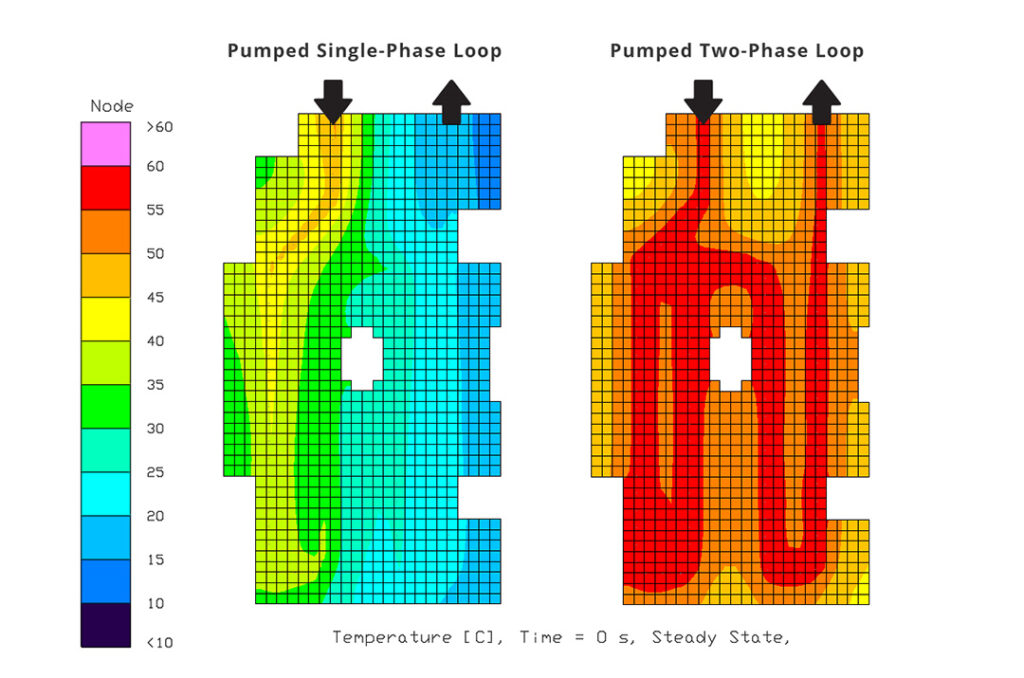
Pumped two-phase loops:
- Keep radiator temperatures highly uniform for efficiency
- Support extremely high chip heat fluxes
- Minimize coolant flow rates and thus size/power draw of pumps
All actively pumped loops (two-phase and single-phase) introduce significant engineering complexity, including:
- Pump reliability
- Leak mitigation
- Pressure control
- Fluid management
- Redundancy architecture
While two-phase loops may not require additional hardware relative to single-phase, they introduce additional potential failure modes, most notably around the pump.
Orbit Selection Matters More Than You Think
Thermal performance and power generation on orbit depend heavily on orbit geometry.
Many orbital data center concepts focus on dawn/dusk sun-synchronous orbits, which maximize solar exposure for power generation. But many of these orbits still experience seasonal changes in sunlight geometry and Earth shadowing. Below certain altitudes, spacecraft will periodically enter “eclipse” conditions, requiring one or more of:
- Battery storage
- Payload throttling
- Thermal transient management
System-Level Optimization
Designing a viable solution for orbital data centers does not depend on a single component or technology. It is a system-level optimization problem balancing:
- Radiator mass
- Solar array area
- Launch cost
- Thermal efficiency
- Reliability
- Redundancy
- Atmospheric drag
- Spacecraft pointing
- Power architecture
High-performance thermal management is a critical enabler for all space activities and will remain so as orbital compute platforms evolve and scale.
ACT’s Role in Space Thermal Management
ACT develops advanced thermal solutions for challenging aerospace environments, from conceptual orbital architectures to flight-proven spacecraft systems.
Our Expertise Includes

Heat Pipes
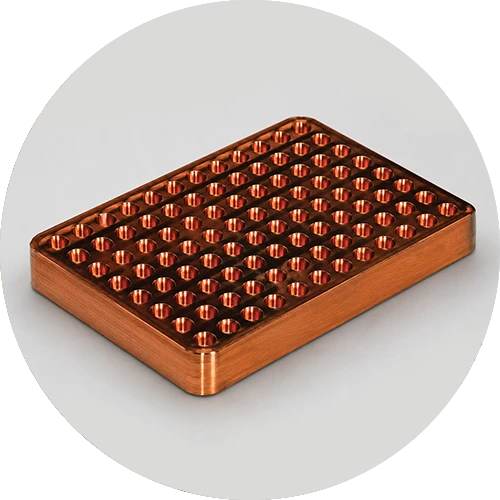
Vapor Chambers
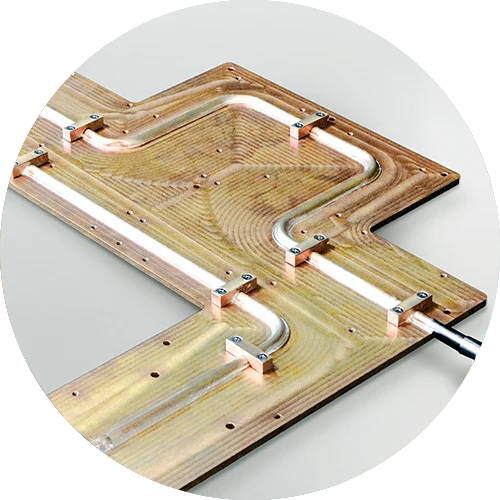
Pumped Fluid Loops
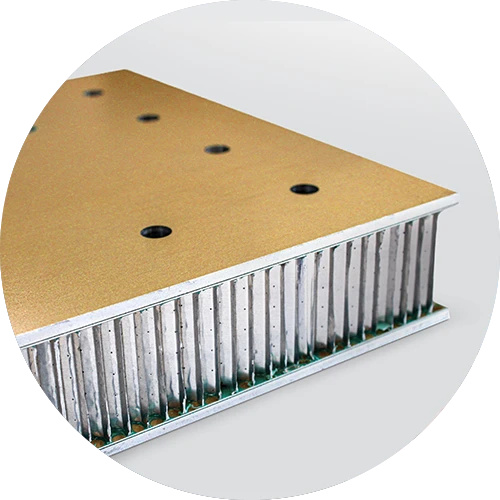
Spacecraft Radiators
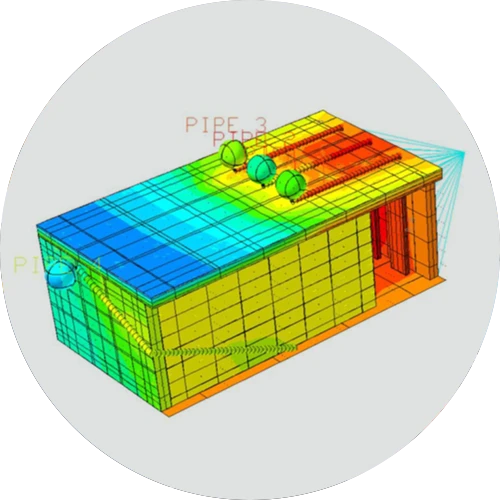
Thermal Modeling and Analysis
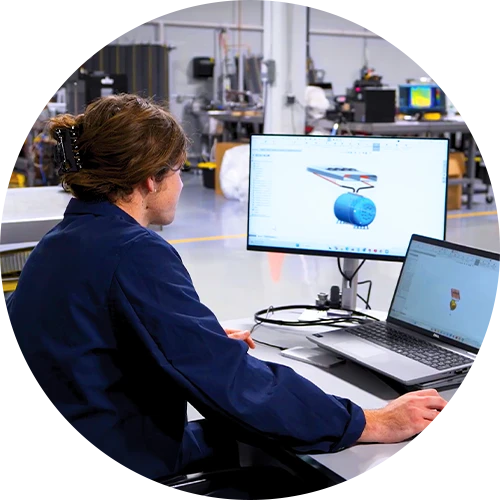
Custom Thermal Hardware Development
As orbital data center concepts continue maturing, thermal engineering will play a defining role in determining what architectures become viable.

