

Re-imagining Medium Voltage SST Cooling with Two-Phase Dielectric Fluids
In the ever-evolving world of shipboard power systems, the push for higher power density and greater system control is driving the adoption of Medium Voltage (MV) Solid State Transformers (SSTs). These next-generation systems promise modularity and efficiency, but they also bring along a significant engineering hurdle: thermal management.
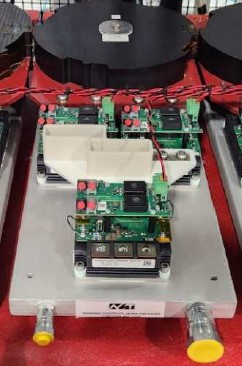
At ACT, we teamed up with RCT Systems to develop and test custom thermal solutions for Power Electronic Building Blocks (PEBBs) used in MV SSTs. The result? A high-performance, electrically isolated, two-phase cold plate system that meets the demanding thermal and electrical requirements of this application.
Why Traditional Cooling Won’t Cut It
Conventional single-phase liquid cooling systems—like water-glycol loops—have served reliably in low voltage (LV) marine and industrial power systems. But as applications shift to medium and high voltage (MV/HV) levels—such as 13.8 kV and above—the limitations of these legacy cooling methods become dangerously clear. Water, while effective at transporting heat, is inherently conductive. In MV/HV environments, even a minor leak can result in catastrophic failure—posing risks of full system loss, electrical arcing, or even fire and explosion.
To mitigate these risks, water-based systems require extensive ancillary infrastructure: continuous health monitoring, detailed leak detection, redundant safety measures, and complex control systems—all of which add cost and complexity. And still, the risk of failure isn’t eliminated—only managed.
Two-phase cooling systems using non-conductive, dielectric refrigerants like R134a offer a safer, more efficient solution for MV/HV power electronics. By leveraging the energy absorbed during phase change, these systems deliver high-performance, isothermal heat transfer without compromising electrical isolation. The implementation costs of two-phase systems are often offset by the reduction—or elimination—of expensive support infrastructure typically required to make water cooling viable and safe in high voltage environments.
When reliability, safety, and performance are non-negotiable in MV/HV systems, it’s clear that traditional cooling just won’t cut it.
Two-Phase Cooling- Efficiency Meets Isolation
Our thermal management system (TMS) is built around a Pumped Two-phase (P2P) loop. As the refrigerant flows through the cold plates, it absorbs heat from SiC-based power modules, causing localized evaporation. This phase change process extracts more heat per unit mass than traditional cooling fluids, enabling smaller flow rates, lower pumping power, and more compact system components.
And because R134a is a dielectric fluid, it offers over 30 kV of electrical isolation when paired with non-conductive plumbing. This is a game-changer for MV systems where creepage and clearance constraints are tight.
Custom Cold Plates for SiC PEBBs
Each MV PEBB includes multiple 3.3 kV SiC MOSFET modules, and their cold plates had to be designed to handle uneven, mode-dependent heat loads. Rather than attempting to individually modulate flow to each module (which adds complexity and cost), we used a clever channel design that routes refrigerant in series through each module. This design ensures relatively uniform heat absorption and stable flow distribution without the need for active controls.
CFD modeling guided our geometry and flow distribution strategy, allowing us to optimize for pressure drop, flow balancing, and two-phase regime stability. We even accounted for acceleration effects as the refrigerant changes phase along the flow path.
Real-World Results: Lab Testing Validates the Design
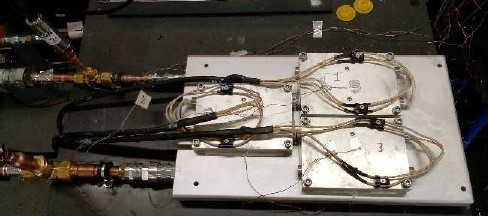
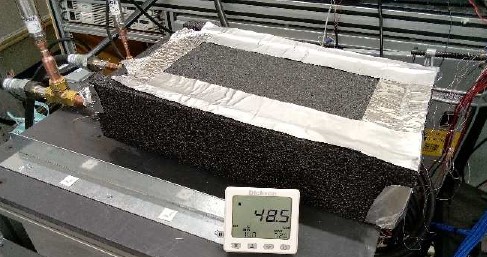
Five production MV cold plates were fabricated using precision-machined aluminum and vacuum brazing. We subjected them to extensive thermal testing at ACT’s in-house two-phase test facility using resistive heaters and real-world power loading profiles.
The results? Across all operational modes—ranging from 200 kW to 450 kW per PEBB—module temperatures remained well within target limits. In fact, our conservative thermal models slightly over predicted temperatures. Even in high-flux scenarios, cold plate-to-cold plate performance varied by less than 2.5°C.
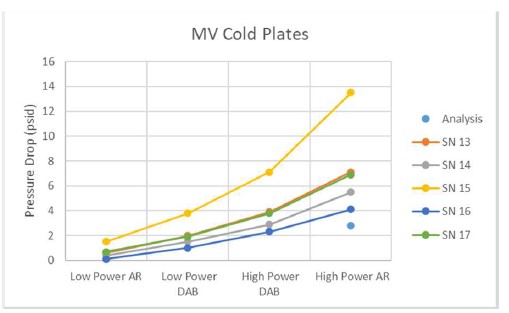
Pressure drop measurements confirmed expected performance, and in one case, highlighted the sensitivity of the system to dry-break connector engagement—an important note for field integration.
What’s Next?
With this cold plate design validated, the next step is integration into full SST hardware for shipboard application testing. As the industry transitions to higher voltage, higher power systems, two-phase dielectric cooling isn’t just a novel idea—it’s rapidly becoming a necessity.
Contact our team to discuss your application.
Advanced Cooling Technologies (ACT) specializes in innovative thermal management solutions for demanding applications. Our work spans industries including defense, energy, space, and power electronics—where performance and reliability are non-negotiable.