


Lightweight, Rigid, and Thermally Uniform - The Next Generation of Spacecraft Radiators
Next-generation spacecraft radiators combine structure and thermal control using honeycomb panels with embedded CCHPs. This approach reduces mass, improves thermal uniformity, and enables reliable performance in extreme environments. Highly customizable and multifunctional, these systems simplify spacecraft design while improving efficiency, integration, and overall mission performance.
KEY TAKEAWAYS
- Next-generation radiators integrate structure and thermal management into a single system using honeycomb panels with embedded heat pipes.
- Mass reduction without sacrificing strength improves launch efficiency and spacecraft performance.
- Embedded CCHPs provide uniform heat distribution and reliable thermal control.
- Designed for extreme environments, including lunar and deep space missions.
- Customizable materials, coatings, and configurations support mission-specific requirements.
- Enables simpler, more integrated spacecraft architectures with fewer components.
Engineering Thermal Efficiency in Spacecraft Design
Spacecraft engineers continually face the challenge of managing heat in environments where convection doesn’t exist. As power densities rise and spacecraft architectures become increasingly compact, thermal control systems must do more with less — less mass, less volume, and fewer interfaces. The solution lies in multifunctional structures that combine mechanical and thermal performance.
One such innovation is the honeycomb radiator panel with embedded Constant Conductance Heat Pipes (CCHPs) — a design approach that merges high structural stiffness with efficient heat rejection. These panels are transforming how spacecraft dissipate thermal energy, enabling lighter, more integrated spacecraft architectures optimized for mission longevity and reliability.
Honeycomb Radiator Panels Where Structure Meets Function
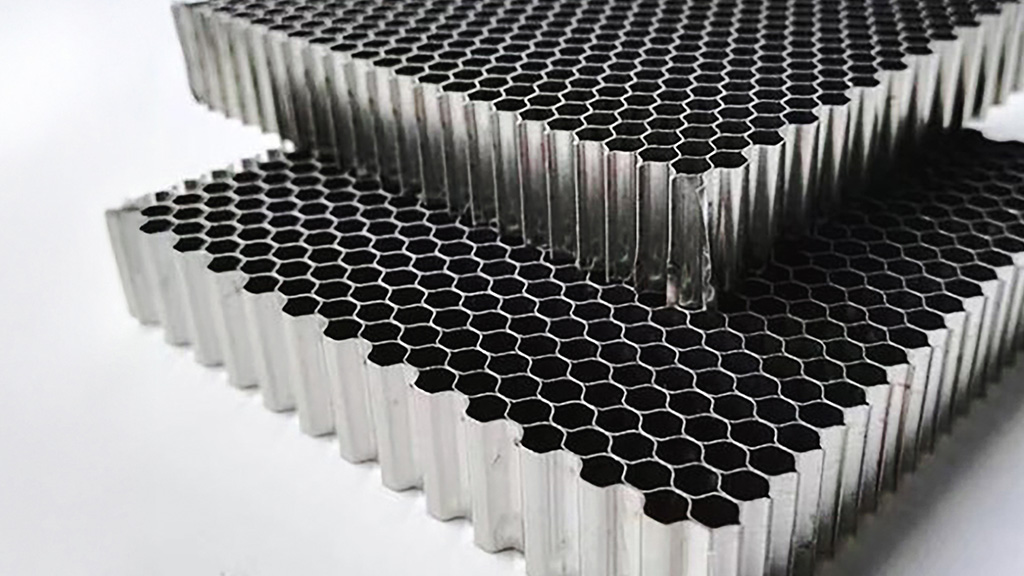
Honeycomb panels are a familiar structural element in spacecraft. Built with thin metallic or composite face sheets bonded to a lightweight core, they offer exceptional stiffness-to-weight ratios, dimensional stability, and configurability. Traditionally, they serve as the spacecraft’s mechanical backbone — providing strength without adding significant mass.
When adapted for radiator service, these same panels become dual-purpose: both structure and heat rejection surface. The face sheet acts as the thermal interface, radiating absorbed energy into space. However, without an effective means to distribute heat evenly across the surface, temperature gradients can limit performance. That’s where embedded heat transport technologies like CCHPs become essential.
The Path to Isothermality with Embedded CCHPs
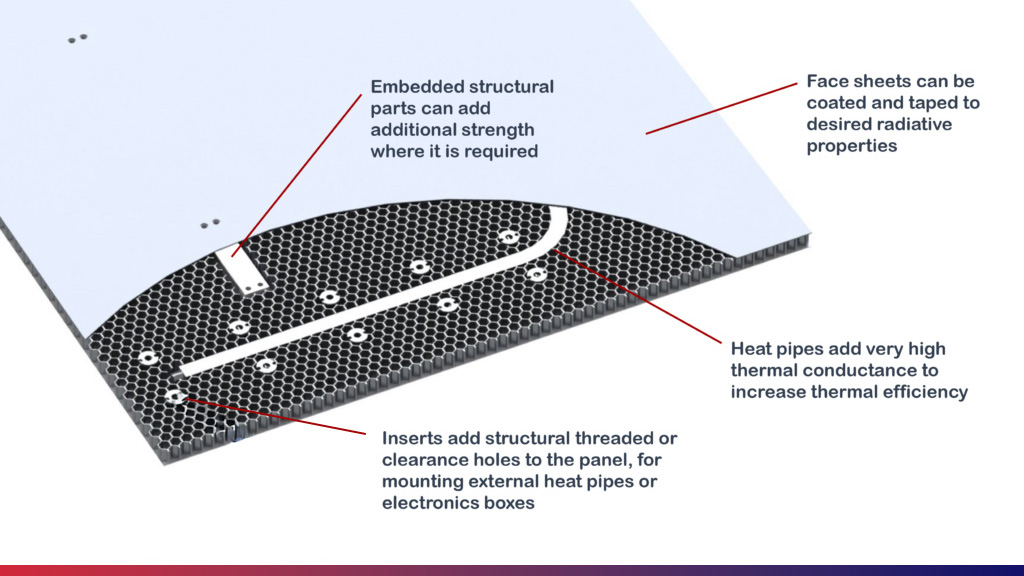
A Constant Conductance Heat Pipe is a sealed device that transports heat through phase change — vaporizing working fluid at hot regions and condensing it at cooler regions, maintaining a uniform temperature along its length. When these CCHPs are embedded within a honeycomb radiator panel, they form a conductive network that spreads heat efficiently from localized sources to the entire radiator surface.
Embedding CCHPs within the panel reduces the extent of external heat pipe routing needed for uniform heat distribution. While some external heat pipes may still be used for point-to-point transport or subsystem interconnection, the internal network of CCHPs provides efficient in-plane thermal spreading. This integration lowers system complexity, mass, and the number of thermal joints that can degrade reliability. Embedding CCHPs, however, demands precision:
- The pipes must be bonded in a way that preserves panel flatness and structural integrity.
- Material selection and bonding techniques must mitigate coefficient of thermal expansion (CTE) mismatch.
- Interface conductance between the CCHP and the face sheet must remain high throughout launch loads and thermal cycling.
Through advanced bonding processes, precision machining, and rigorous inspection, ACT engineers ensure each panel maintains mechanical and thermal uniformity — critical for high-performance spacecraft systems.
Performance Advantages for Space Missions

Thermal Uniformity
Embedded CCHPs maintain near-isothermal performance across the radiator face, mitigating localized hot spots and protecting temperature-sensitive components.

Mass and Volume Efficiency
By integrating structural and thermal functions, honeycomb radiator panels eliminate redundant supports and tubing, enabling more compact, lightweight spacecraft designs.

High Thermal Conductivity
The distributed heat pipe network creates an effective in-plane thermal conductivity several times higher than aluminum alone — allowing smaller radiators to handle higher heat loads.

Structural Strength and Stability
The honeycomb core and bonded face sheets provide rigidity to support mounted hardware or external panels while withstanding launch vibration and shock.

Reliability and Simplified Integration
Reduced joint count and internalized heat transport paths mean fewer failure points, streamlined assembly, and higher system reliability through qualification and launch.
Applications Across Mission Environments
- Low Earth Orbit (LEO): Compact satellite buses benefit from integrated CCHP radiators that dissipate concentrated electronics heat loads efficiently in tight packaging.
- Geostationary (GEO) Communications Platforms: Large-area radiators achieve improved temperature uniformity and structural stiffness, maintaining pointing stability and consistent performance.
- Lunar and Deep Space Missions: Extreme thermal environments demand radiators with predictable conductance and mechanical robustness — both hallmarks of embedded-CCHP designs.
- Small Satellites and CubeSats: Scaled-down honeycomb panels bring high-performance thermal spreading to small form-factor spacecraft where mass and space are critical.
Design Flexibility and Mission-Specific Customization
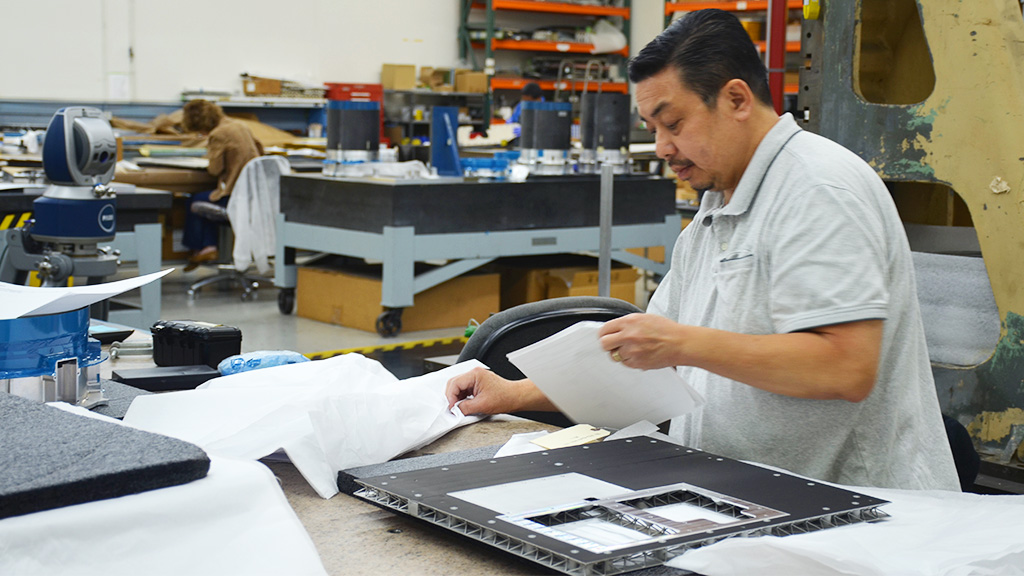
ACT’s engineering teams tailor every honeycomb radiator panel to meet mission-specific requirements. Material combinations — from aluminum and titanium to advanced composites — are optimized for strength, conductivity, and CTE compatibility. The CCHP layout, working fluid selection, and face sheet coatings are configured to balance thermal performance with optical properties suited for the space environment.
Panels can also incorporate embedded heaters, thermal sensors, and mounting interfaces, supporting end-to-end integration within spacecraft subsystems. With in-house modeling, fabrication, and testing, ACT delivers radiators fully qualified for mission performance and environmental durability.
The Future of Multifunctional Spacecraft Structures
Honeycomb radiator panels with embedded CCHPs represent a fundamental shift toward multifunctional spacecraft design — where structure, thermal control, and system integration converge. By uniting high stiffness, low mass, and superior thermal spreading, these panels enable the next generation of efficient, reliable spacecraft.
For mission designers seeking to optimize performance, every gram and every watt counts. Embedded-CCHP honeycomb radiators deliver both.

