


NVIDIA's Warm-Water Cooling Shift and Its Implications for AI Data Center Infrastructure
NVIDIA’s move toward warm-water liquid cooling marks a structural shift in how thermal responsibility is distributed inside AI data centers. As allowable inlet temperatures rise, thermal margin shrinks, transferring stability requirements from facility cooling headroom to the precision of cold plates, CDUs, and hydraulic control architectures. In this environment, predictable behavior—not just capacity—becomes the foundation of scalable AI infrastructure.
Key takeaways
- Warm-water cooling increases performance demands on cold plates, CDUs, and hydraulic controls
- Higher inlet temperatures reduce thermal margin, making consistency and flow uniformity essential.
- Complexity shifts upstream: system stability depends on cold plate design, pressure management, and control-loop behavior.
- Two-phase cooling is naturally aligned with elevated inlet operation due to lower mass flow and favorable thermodynamics.
- Scalable warm-water systems depend on predictable behavior under full load, partial load, and transient conditions.
Understanding Warm-Water Shift
NVIDIA’s adoption of higher allowable inlet temperatures—up to 45°C as announced at CES 2026—redefines operating boundaries for AI liquid cooling. Historically, high-performance data centers relied on cold facility water (≤30°C) to preserve thermal margin, simplify flow distribution, and mask minor hydraulic imbalances. This approach worked, but demanded mechanical chilling and limited scalability as rack densities climbed.
Warm-water architectures reduce the need for mechanical cooling, improve PUE, and open opportunities for heat reuse. But they also tighten chip-to-fluid ΔT, exposing sensitivities that used to be absorbed by cold water and generous thermal headroom. Repeatable thermal resistance, flow balance, and stable control response become primary engineering constraints.
Warm-water cooling delivers efficiency. Achieving reliability within those constraints requires precision.
Cold Plate Performance Under Reduced ΔT
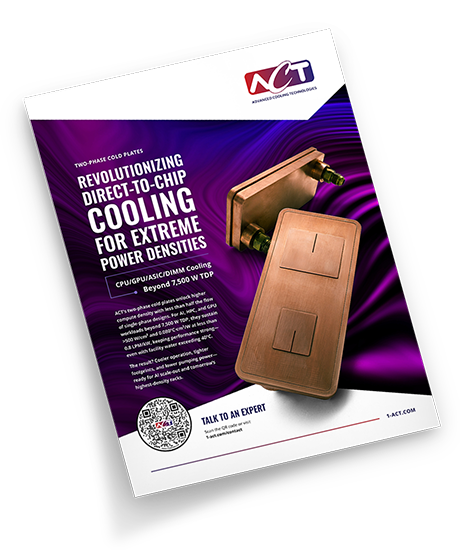
As ΔT shrinks, cold plate design accuracy becomes critical. Engineers evaluating elevated inlet operation often ask how performance varies under reduced margin and higher temperature boundaries. ACT’s two-phase cold plate technical overview provides data on thermal resistance, flow requirements, and validation across elevated inlet scenarios.
Why Complexity Moves Upstream
Raising facility water temperature doesn’t eliminate thermal challenges—it relocates them into the components and controls where stability is determined. At higher inlet conditions, cooling loops become more sensitive to:
- Flow imbalance across parallel branches
- Localized high heat flux behavior
- Transient load changes
- Pump and valve control response
- Loop dampening and oscillation risk
Where facility-level thermal headroom once masked deviations, warm-water conditions reveal them as plate‑to‑plate variance, pump cycling, or unpredictable control behavior. Hydraulic stability and control-loop tuning now have direct impact on thermal predictability.
Complexity concentrates upstream, where component-level precision determines system stability.
Two-Phase Cooling in Warm-Water Architectures
Two-phase cooling aligns naturally with elevated inlet operations because it relies on latent heat transfer, not large temperature swings, to remove high heat flux. This enables:
- Significantly lower mass flow rates compared with single-phase cooling due to vaporization-based heat absorption
- Reduced pumping power and lower distribution pressure drop, since the system does not depend on high flow velocities
- Smaller piping and manifolds, enables by reduced volumetric flow.
- More predictable flow sharing, provided the cold plates are engineered to suppress boiling instabilities
Two-phase cold plates operating at warm-water inlet temperatures (>35°C) can sustain stable thermal resistance at high heat flux when microchannel or jet-impingement geometries are used. Scalable two-phase CDUs—from rack-scale to multi-MW implementations—support phased rollout and predictable AI cluster expansion.
Engineering for Elevated Inlet Operation
Achieving stability at higher inlet temperatures requires:
- Cold plate geometries optimized to promote controlled boiling and uniform surface temperature
- Hydraulic distribution networks that ensure uniform inlet quality and mitigate pressure-driven oscillations
- System architectures that dampen transient behavior and maintain vapor quality control
- CDUs designed to regulate temperature and pressure at elevated inlet conditions
- Validation under real workload patterns, since boiling dynamics depend strongly on transient power draw
As inlet temperatures rise, system reliability increasingly depends on component precision and coordinated control across the cooling loop. For hyperscale engineers, the real question is no longer whether warm-water cooling is feasible—it’s whether the architecture delivers consistent, repeatable behavior at scale.

