This cleanroom humidity control case study highlights how Hanlim Pharmaceutical Co., Ltd., a South Korean manufacturer of ophthalmic, injectable, and oral solid-dose pharmaceuticals, maintains strict environmental conditions in its GMP-compliant facilities that meet U.S. FDA standards. These operations run continuously year-round, requiring cleanroom temperature and humidity to remain within tight limits to protect product quality, regulatory compliance, and operator comfort.
During increasing humid summer conditions, Hanlim began experiencing recurring humidity deviations in its GMP cleanrooms, Elevated outdoor humidity pushed existing HVAC systems beyond their original design limits, creating operational strain and compliance risk. Expanding cooling capacity would have required new mechanical systems, higher energy consumption, and increased carbon emissions—conflicting with Hanlim’s cost-control goals and ESG commitments.
Instead, Hanlim installed ACT’s Wrap-Around Heat Pipe Heat Exchangers (WAHX) on selected air handling units. The passive technology enhanced latent cooling performance without adding chillers, boilers, or complex controls.
Over four years of verified operation, the solution eliminated summer humidity deviations, reduced combined electricity and LNG costs by more than $350,000, and lowered carbon emissions by 1, 025 metric tons of CO2e. Peformance was validated using utility meter data, building management system records, and energy bills.
The project demonstrated how Hanlim advances operational reliability, regulatory compliance and sustainability goals through proven efficiency technologies—without increasing system complexity or long-term energy use.
The Challenge
Recurring Summer Humidity Deviations
Rising summer temperatures and humidity exceeded the original HVAC design parameters. Peak conditions overwhelmed the system’s ability to remove moisture from incoming air, causing intermittent humidity excursions in GMP production areas.
These instability risks threatened batch quality, product stability, and added oversight burdens. Fluctuations also reduced worker comfort, increasing fatigue in hot months.
Rising Costs, Limited Options
With 24-hour, 7-days-a-week cleanroom operations, HVAC presented one of the facility’s top energy loads. Adding cooling capacity risked increasing energy consumption by 30% or more, conflicting with the cost-control objectives and sustainability targets.
Hanlim sought a solution to:
Stabilize humidity during peak conditions
Reduce energy consumption
Deliver a proven ROI
Avoid installing new mechanical systems
The Solution: ACT WAHX
Partnering with HP Engineering (ACT’s Korean representative), Hanlim retrofitted WAHX units into key air handling units for critical areas.
How it Works:
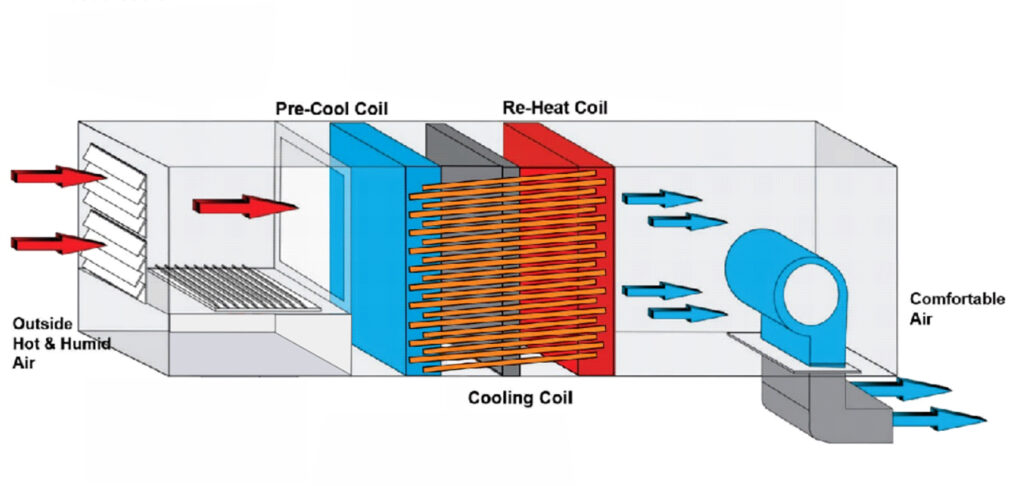
The passive, gravity-assisted thermosyphon heat pipes transfer heat around the cooling coil—no pumps, compressors, or power needed.
Upstream Pre-Cool Coil
Warm, humid air cools via sensible heat absorption before the active coil. This boosts latent (moisture) removal without extra chiller load—enabling deeper dehumidification.
Downstream Reheat Coil
Recovered heat reheats air to neutral temperature post-cooling, eliminating electric, steam, or hot-water reheat.
Figure 1. Wrap-Around Heat Pipe Heat Exchanger (WAHX) in typical air handler. Pre-cooling coil (left) reduces entering air temperature for tonnage savings; reheat coil (right) recovers energy post-cooling for MBtu savings.
Why This Approach Worked:
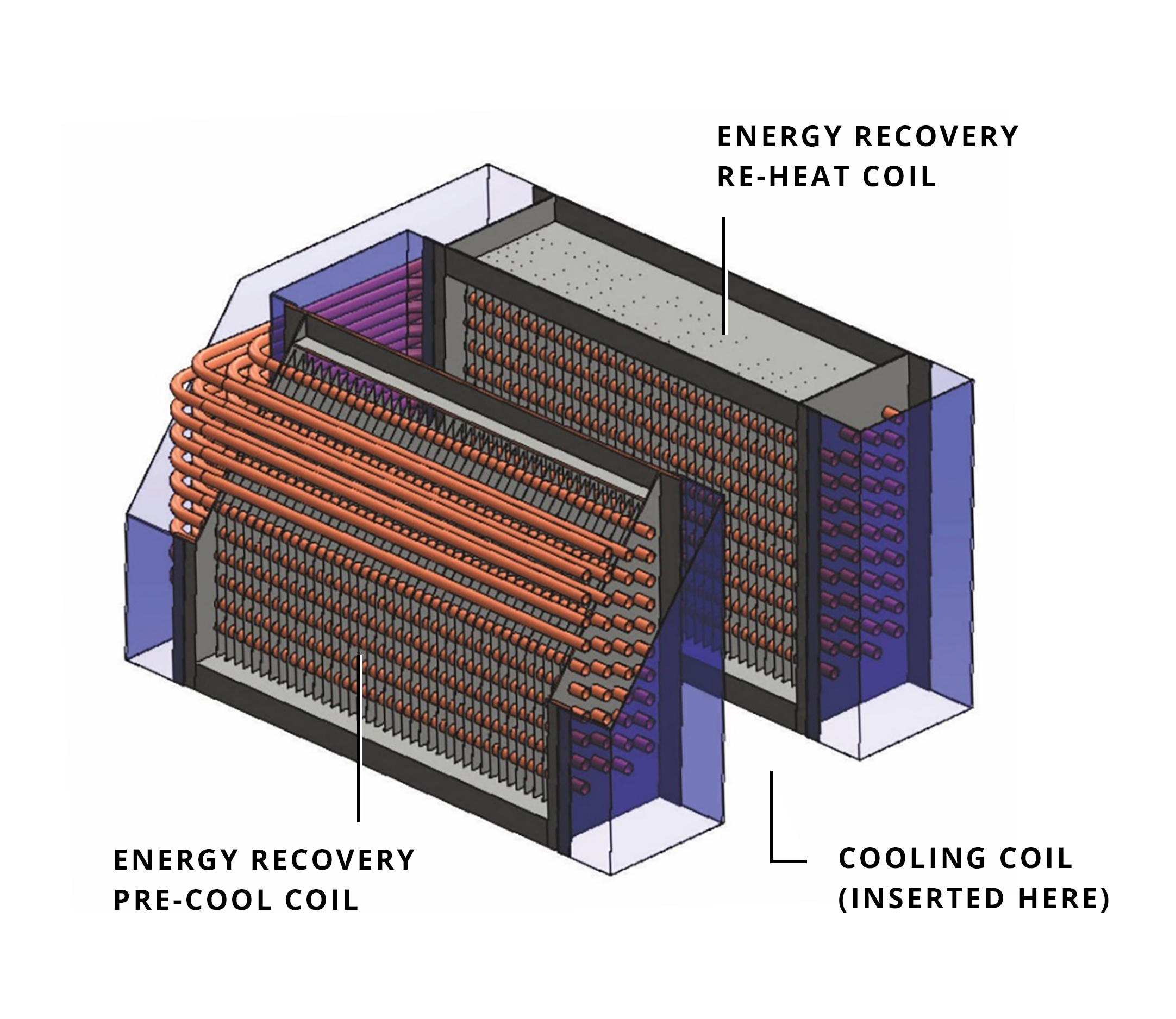
By shifting sensible heat upstream and downstream of the cooling coil, the WAHX effectively changes the coil’s sensible heat ratio. This allows the system to remove more moisture while reducing mechanical cooling demand.
Part of the cooling load is handled passively, which lowers compressor runtime and reduces chilled-water plant load. At the same time, recovered heat replaces traditional reheat energy.
The result is deeper dehumidification, lower energy consumption, and simpler operation—all achieved through passive heat transfer.
Implementation
WAHX units were installed on selected air handling units based on ROI potential, environmental impact, and production criticality.
The retrofit was completed without disrupting ongoing pharmaceutical operations. The systems were integrated into existing AHUs with minimal modification.
Figure 2. ACT WAHX wraps around chilled water cooling coil, boosting dehumidification capacity while eliminating reheat energy demand.
The Performance Results
Recurring Summer Humidity Deviations
Following installation of ACT’s Wrap-Around Heat Pipe Heat Exchangers, Hanlim Pharmaceutical observed immediate improvements during peak summer conditions. Humidity remained stable, mechanical reheat demand was eliminated, and cooling performance improved through passive pre-cooling. These results were confirmed through a four-year analysis of utility meter data, BMS records, and energy billing statements, accounting for variations in production volume, operating rates, and seasonal weather conditions.
Operational Performance Summary
Metric
Pre-Installation
Post-Installation
4-Year Impact
Summer Humidity Deviations
Frequent deviations
Eliminated
GMP compliance upheld
Cooling Capacity
Limited latent removal during high humidity
Increased through passive pre-cooling
Stable cleanroom performance during peak loads
Humidity-Related Batch Risk
Elevated risk
Effectively eliminated during peak conditions
Improved production stability
Steam Reheat Usage
Steam reheat active
Steam valves fully closed
Steam reheat eliminated
Electric Reheat Usage
Electric reheat active
Significantly reduced
Electric reheat demand significantly reduced
Energy Cost Savings
N/A
Reduced mechanical cooling and reheat demand
Over $350,000 (electricity + LNG)
CO₂e Reduction
N/A
Reduced overall HVAC energy use
1,025 metric tons
Workforce Feedback
Fatigue complaints during peak humidity
Highly positive
Improved comfort and productivity
COnclusion
This collaboration between Hanlim, HP Engineering, and ACT demonstrates how passive heat recovery can solve pharmaceutical cleanroom humidity challenges—stabilizing control, reducing energy and carbon impact, and improving working conditions without added mechanical complexity.
“The adoption of heat pipe technology has enabled stable facility operation in full compliance with GMP regulations. Our production department has provided positive feedback on improved environmental conditions and productivity.
The verified energy savings were calculated from utility meters, BMS data, and energy bills, reflecting real-world variables such as production volume, operating rates, and weather conditions.
This project demonstrates our ongoing commitment to ESG management and sustainable manufacturing practices.”
Mr. Sungnara Lee, Team Leader of Technical Support, Hanlim Pharm
Mark Stevens
HVAC & Enclosure Cooling Product Specialist
See What Energy Savings Are Possible in Your Facility.
Get a quick, no-obligation assessment from an ACT specialst.