


Thermal management is critical for spacecraft systems, where payloads and electronics must operate reliably across extreme temperature variations. Conventional heat pipes (CCHPs, VCHPs, and DHPs) provide robust solutions but often require complex materials and processes, increasing cost and mass and limiting flexibility. The Thermo-Modulating Heat Pipe (TMHP) was developed to address these challenges by simplifying design, reducing cost, and providing both variable conductance (VCHP effect) and diode effect on heat transfer capabilities.
How a Thermo-modulating Heat Pipe Works
The TMHP is a gas-charged standard aluminum–ammonia heat pipe that eliminates the need for a traditional non-condensable gas (NCG) reservoir. Its simplified design lowers cost and mass while enabling additional radiating surfaces on satellites. By modulating conductance, the TMHP allows adaptive heat transfer depending on temperature conditions.
Design Features
- Uses the same materials and processes as simple grooved CCHPs, but with added NCG.
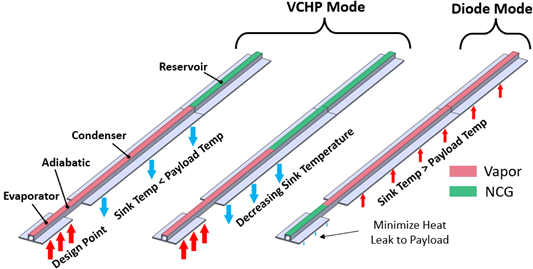
- The NCG, which controls the heat transfer, is stored in the condenser during normal operation.
- VCHP Mode (direct/regular heat transfer): NCG incrementally blocks the condenser at lower sink temperatures, regulating heat transfer from the payload.
- Diode Mode (reversed transfer): NCG fully blocks the evaporator to prevent backflow of heat, minimizing heat leak into the payload.
Capabilities
- Thermo-modulating: Thermal conductance passively varies with condenser temperature, minimizing the thermal impact on the payload.
- Diode Effect: Heat transfer is favored in one direction and is blocked in the opposite direction when the temperature gradient reverses.
Combined, these capabilities allow TMHPs to act as both VCHPs and DHPs in a single, streamlined device.
Applications
1. Geosynchronous Satellites
- TMHPs enable efficient cooling using East/West panels, one of which is always out of direct sunlight.
- This effectively provides a third radiating panel, improving overall thermal balance.
2. Geosynchronous Satellites with Deployable Radiator Panels (DRPs)
- Supports expanded radiator architectures for higher heat dissipation needs.
3. Radiator-Mounted Electronics
- Electronics units often mount directly to radiators, complicating isolation from environmental extremes.
- TMHP evaporators can be placed beneath units, while condensers mount to radiators or to other heat pipes in the network.
- This allows isolation of electronics from most of the radiator’s thermal influence, except for direct conduction, ensuring stable operation.
- Provides thermo-modulation in both hot and cold environments.
4. Reduced Visibility Low Earth Orbit (LEO)
- TMHPs allow black radiators to remain cooler, reducing thermal signature.
- Enables efficient rejection of heat off counter-facing surfaces, valuable in low-profile satellite designs.
Performance Example
An experimental demonstration showed distinct behavior in VCHP and Diode Modes:
- VCHP Mode (Forward Heat Transfer): At ~36 W load, TMHP transfers heat efficiently from payload to radiator. Conductance increases as radiator temperature rises.
- Diode Mode (Reverse Blocking): As radiator temperature exceeds payload temperature (temperature gradient reverses), NCG blocks vapor pathways, preventing backflow. Conductance drops sharply, isolating the payload from unwanted heating.
This dual behavior highlights TMHP’s adaptability across operational regimes.
Benefits and Impact
- Cost Efficiency: Simpler design reduces manufacturing complexity compared to traditional VCHPs/DHPs.
- Lightweight: It has lower mass than a VCHP or a DHP with a traditional reservoir (typically made of stainless steel)
- Flexibility: Supports new thermal architectures, including additional radiating surfaces and deployable radiator concepts.
- Reliability: Reduces thermal stress on electronics and payloads by preventing reverse heat flow.
- Enhanced Performance: Expands satellite mission capability in both GEO and LEO environments.
The Thermo-Modulating Heat Pipe represents a significant advancement in spacecraft thermal management. By combining the functions of a VCHP and a DHP in one streamlined design, it offers cost and mass savings, design flexibility, and improved reliability. Its demonstrated performance makes it a compelling solution for future satellite platforms, especially where thermal adaptability and protection from environmental extremes are critical.
