

Pumped Two-Phase Cooling in Spacecraft - The Need for Active Cooling in Space
SpaceX’s Starship and Blue Origin’s New Glenn are just two results of a growing demand for larger, heavier, and more complex payloads sent to space. For example, New Glenn recently launched a prototype in support of the Blue Ring platform. The goal of Blue Ring is to provide support to payloads greater than 3000kg by repositioning or adjusting their orbit, refueling, transporting components, and relaying data. Traditional spacecraft cooling such as passive Constant Conductance Heat Pipes (CCHPs) or thermal straps, in reasonable quantity, do not have the heat transport capability to support these large, high-power spacecraft. That’s where sophisticated cooling solutions are needed . ACT’s Pumped Two-Phase (P2P) systems with mechanical pumps harness the latent heat of vaporization. They utilize the energy required to convert a liquid into gas—to transfer heat from critical components to the working fluid.
Advantages over traditional cooling methods
Pumped Two-phased (P2P) cooling systems provide distinct performance advantages over traditional single-phase solutions, primarily due to the thermodynamic benefits of phase change heat transfer. Their compact form factor and reduced mass result from the high latent heat of vaporization, which enables efficient heat removal with lower mass flow rates. In contrast, single-phase systems rely on sensible heat transfer, necessitating larger pumps and higher volumetric flow rates to achieve comparable thermal performance.
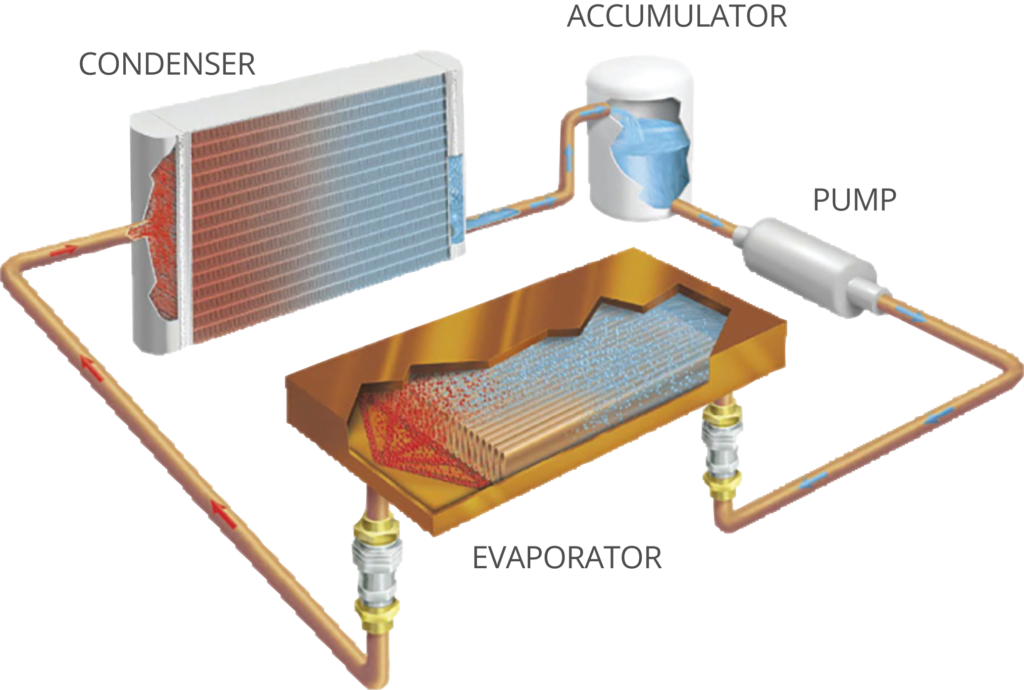
A key advantage of P2P systems is their ability to maintain effective operation regardless of orientation. This is achieved through a mechanical pump that circulates both liquid and vapor phases, ensuring consistent thermal transport even in microgravity environments—a critical factor for spacecraft thermal management. These characteristics make P2P systems particularly well-suited for high-power applications that demand precise thermal control, including optical systems, high-energy lasers, and active phased array antennas.
The Heat-Controlled Accumulator: Core Thermal REgulation in P2P Systems
A fundamental component of any pumped two-phase (P2P) system is the heat-controlled accumulator (HCA), which plays a vital role in system stability and performance. The HCA serves two primary functions:
- Regulating the evaporator’s saturation temperature to maintain optimal thermal conditions and prevent temperature fluctuations.
- Delivering a steady, vapor-free liquid supply to the pump, ensuring reliable operation and mitigating performance degradation.
The importance of the HCA stems from its ability to suppress vapor entrainment in the liquid stream. If vapor bubbles were to reach the pump inlet, they could induce cavitation, generating high-energy shock waves that lead to mechanical degradation. This cavitation not only diminishes pump efficiency but also accelerates material erosion within the pump, potentially compromising long-term reliability. By precisely managing the liquid-vapor equilibrium, the HCA ensures robust and efficient operation of the P2P system across a range of thermal and operational conditions.
Temperature and Pressure: A Delicate Balance
The heat-controlled accumulator (HCA) employs integrated heaters to precisely regulate the working fluid’s temperature and pressure, ensuring stable two-phase operation. Maintaining this delicate equilibrium is essential due to the following thermal and fluid dynamic constraints:
- Excessive pressure can induce premature vapor formation, leading to unwanted bubble generation within the liquid stream.
- Insufficient pressure can result in reduced flow rates and pump starvation, which degrades pump efficiency and disrupts system-level thermal management.
Space Specific design considerations
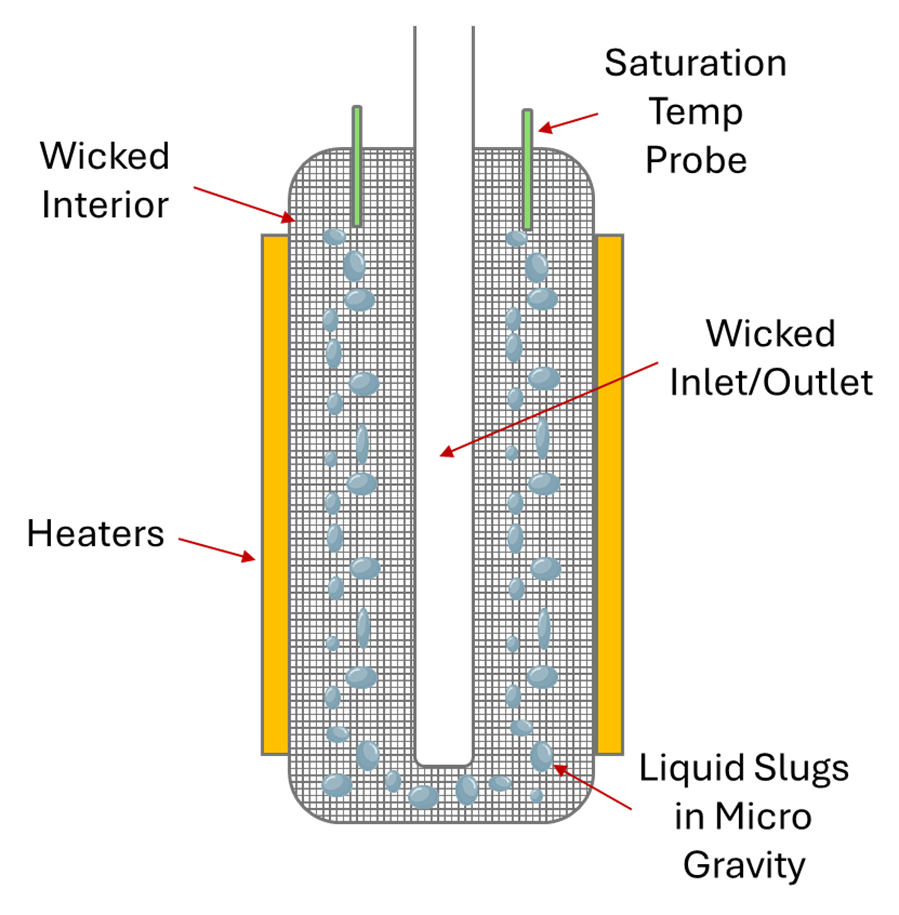
Spaceborne HCAs incorporate advanced design enhancements to compensate for the absence of gravity-driven fluid behavior. A key differentiator is the integration of a capillary wick structure, which facilitates:
- Uniform liquid distribution across the HCA’s outer surface, optimizing heat input and phase stability.
- Enhanced thermal coupling, improving heat transfer efficiency and ensuring precise saturation temperature control.
- Complete vapor phase elimination, preventing entrained bubbles from reaching the pump and mitigating cavitation risks.
These specialized design adaptations ensure continuous, bubble-free liquid delivery to the downstream pump, maintaining high-performance thermal regulation in the extreme conditions of space.