


- HiK™ Plates/ Heat Pipe Assemblies
- Heat Pipes 101
- Different Types of Heat Pipes
- Heat Pipe Design Guide
- Pulsating Heat Pipes
- Vapor Chambers
- High Temperature Heat Pipes
PHPs, similar to traditional heat pipes, utilize passive two-phase (liquid-vapor) operation to effectively transfer heat. Despite this similarity, the operation is quite different. Pulsating heat pipes do not utilize wick structures to drive the liquid return; instead, they operate with internal pressure pulsations that transfer the liquid and vapor slug within mini/micro, serpentine channels. A pulsating / oscillatory locomotion of liquid between the evaporator and condenser allows for both sensible and two-phase heat transfer, which can be very effective for localized component cooling.
What Are Pulsating Heat Pipes?
Pulsating Heat Pipes (PHPs), often referred to as Oscillating Heat Pipes (OHPs), were introduced in the 1990s by Akachi as a passive heat transfer device that uses pulsation (oscillation) of liquid slugs and vapor plugs to transport heat. Since that time, significant effort has been put into developing the technology so that the operating physics are understood, performance can be predicted, and it can be produced to reliably operate for the significant lifetime requirements –often more than 15 years – needed for spaceflight use. Recent operational successes/heritage in space have enabled the pulsating heat pipe to be utilized in the challenging realm of spaceflight thermal control.
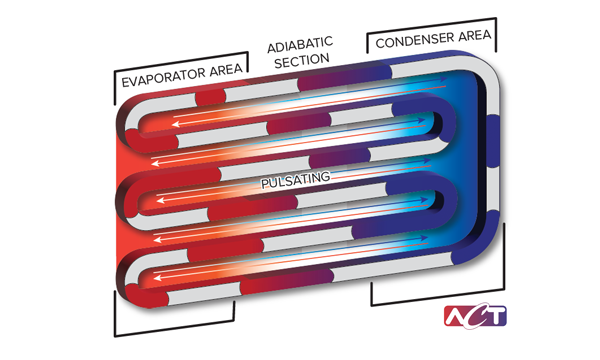
A PHP consists of:
- A long, small-diameter capillary tube bent into many turns
- Partially filled with a working fluid (water, ammonia, acetone, etc.)
- Three regions:
- Evaporator (heat input)
- Adiabatic section
- Condenser (heat rejection)
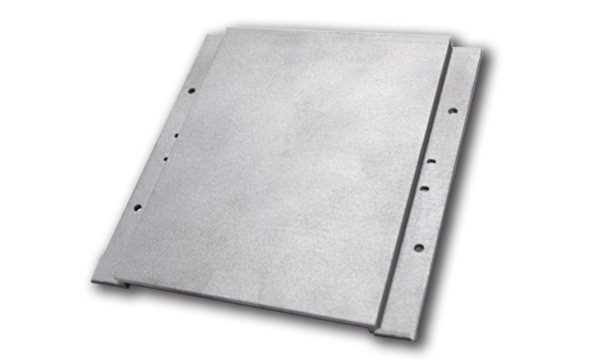
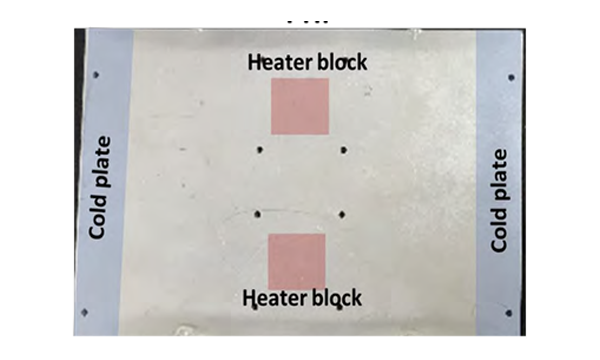

How do Pulsating Heat Pipes Move Heat?
Pulsating Heat Pipes generally consist of plain, meandering tubes/channels with many U-turns; one end of the channels is in contact with an evaporator and the other end is in contact with a condenser. The channels are partially filled with a working fluid that best fits the application (eg. Ammonia, propylene, .). While most heat pipes contain a wick structure and rely on latent heat to complete energy transfer, the pulsating heat pipe contains no wick structure and energy is transferred by a combination of sensible (achieved by frequent fluid slugs traveling through the evaporator and condenser) and latent heat. As a fluid slug travels through the evaporator region, small amounts of liquid vaporize; the vapor generation increases pressure and propels the fluid slug(s) through the channel where it reaches and deposits energy stored to the condenser. This closed system allows this exchange to continue indefinitely.
What Happens Inside:
- Heat is applied at the evaporator.
- Liquid segments vaporize, forming expanding vapor bubbles.
- This expansion pushes adjacent liquid slugs.
- At the condenser, vapor condenses.
- Pressure differences cause the fluid to oscillate back and forth.
The result is a self-sustained oscillatory motion that transports heat very effectively.
Why Customers Use Pulsating Heat Pipes
- Thermal Performance (Low resistance, high heat flux capabilities)
- Thin Profile
- Low Mass/Lightweight
- Scalable and compact
- Can operate in various orientations
- Geometric Flexibility (small channels allow for tight turns and 3D shapes)
Fluid Options:
Like traditional heat pipes, there are many compatible options available depending on your operating temperature range and system requirements. Common fluid options include:
- Ammonia
- Propylene
- R245fa
Applications in Advanced Systems
For rugged systems, defense, aerospace, or space applications, PHPs are attractive because they:
- Offer high performance with low mass
- Have fewer internal structures
- Can be embedded into cold plates or panels
- Are adaptable to tight packaging constraints
Pulsating Heat Pipe Capabilities for Space and Orbital Systems Applications
Pulsating Heat Pipes are a complementary technology to Space Copper Water Heat Pipes (SCWHPs). While they generally can’t carry as much power and need a minimum temperature difference to start-up, the lack of a wick structure and alternate working fluid selections provide many applicable use cases for spaceflight:
- Unique geometries
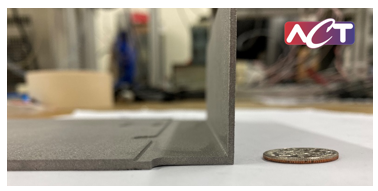
- Small cross-sectional channel dimensions can result in parts of < 3mm thickness
- No wick structure and enhanced manufacturing approaches (aluminum vacuum brazing, 3d printing) enable 3-dimensional channel routings.
- Highly cyclic (LEO) environments
- Working fluid can be selected to avoid freezing the working fluid, a typical challenge of SCWHP implementation in LEO spacecraft
- Some common fluids include ammonia, propylene, acetone, refrigerants, etc.
- Design Flexibility on Transport Length
- PHPs can be implemented in both volume-constrained (eg. board-level) environments, and long distances where energy needs to be transported long distances (>1m)
The internal channels are purposely designed to have a small cross-sectional area to induce capillary force on the fluid fill. This geometry causes the working fluid to naturally form into liquid slugs and vapor plugs throughout the system, removing the chance that liquid will fully accumulate in a single location. This yields the following benefits of the technology:
- PHP can be successfully operated on the ground in adverse (evaporator above condenser) orientations
- This enables flexibility in spacecraft testing
- The fluid will be inhibited from accumulating in a single location
- The evaporator will contain fluid, removing the possibility of start-up failure due to “dry” evaporator in-flight operation.
How are Pulsating Heat Pipes used in Space Applications?
PHPs tend to be best suited for board-to-chassis-level heat transport applications due to their:
- Low mass
- Geometric Flexibility
- Potential for thin profiles
- Thermal performance capability regardless of orientation
The validity of using PHPs over alternative available enhanced thermal technologies – such as SCWHPs, HiK™ Plates/Cards, Constant Conductance Heat Pipes (CCHPs), etc. – will depend on your specific application and heat transfer requirements. ACT has a wealth of experience in identifying and designing optimal thermal control systems for SWaP, cost, and lead time. Through two decades of experience growing our manufacturing footprint for a wide range of products and applications, we have the manufacturing know-how and supply chain to meet production and quality requirements. As the demand for PHPs increases, ACT is positioned to meet design, qualification and high-quality production requirements.
Why ACT?
Developed through internal and government funding, ACT has spent many years developing in-house modeling tools to reduce design cycles and improve performance predictability. Through two decades of experience growing our manufacturing footprint for a wide range of products and applications, we have the manufacturing know-how and supply chain to meet production and quality requirements. As the demand for oscillating heat pipes increase, ACT will be best positioned to meet design, qualification and high quality production requirements.
Discuss your thermal challenge with ACT engineers.


